

2026 BUDGET SPEECH – AE Investment Managers
March 2, 2026
Monthly Market Overview – March 2026
April 16, 20262026 BUDGET SPEECH – AE Investment Managers
March 2, 2026Monthly Market Overview – March 2026
April 16, 2026NEWS
Monthly Market Overview
FEBRUARY 2026 IN REVIEW
ECONOMIC AND MARKET OVERVIEW
On 28 February 2026, the United States and Israel launched coordinated military strikes on Iran, targeting nuclear and military facilities. Iran retaliated with missile attacks on Israel and US bases, while drone incidents spread across Gulf states. The announcement of the death of the Iranian leader Ayatollah Ali Khamenei plunged the Middle East into heightened instability and raised global energy security concerns.
President Cyril Ramaphosa delivered his State of the Nation address on 12 February 2026, emphasising infrastructure investment, expanded social safety nets, and optimism about economic growth. He declared South Africa was “on the cusp of rapid growth,” highlighting job creation and investment as priorities. Markets received President Ramaphosa’s 2026 State of the Nation Address with cautious optimism, with investors welcoming the emphasis on reform and green growth, but noted that execution remains the key risk.
President Trump nominated Kevin Warsh as the next Chair of the Federal Reserve. Warsh is expected to pursue aggressive balance sheet reduction and a “Sound Money” doctrine, signalling tighter monetary policy. Markets reacted with a sharp bear steepening of the yield curve, reflecting expectations of higher long term rates.
Speculation intensified in February that Christine Lagarde may step down early as European Central Bank President. Potential successors include Klaas Knot (Netherlands) and Pablo Hernández de Cos (Spain), with broader restructuring of the ECB’s Governing Council under discussion. An early transition could reshape eurozone monetary policy amid political uncertainty in France.
On 20 February 2026, the Supreme Court ruled 6 against 3 that President Trump’s emergency tariffs under the International Emergency Economic Powers Act (IEEPA) were unconstitutional. The decision invalidated tariffs worth over $200 billion, reinforcing Congress’s sole authority to levy taxes. Trump retaliated by vowing new trade measures, escalating tensions with importers and trading partners.
South African Finance Minister Enoch Godongwana delivered the 2026 Budget on 25 February, stressing fiscal discipline while supporting growth. Key measures included balancing debt sustainability with social spending, and funding infrastructure aligned with SONA priorities. Analysts noted the possible tension between President Ramaphosa’s ambitious promises and the Treasury’s cautious allocations.
MARKET PERFORMANCE
Global equity markets continue to perform strongly, with equities in emerging markets (up 5.5% in US dollars) outperforming developed markets (up 0.8%) for the third consecutive month. Over the last three years, these two markets have delivered very similar returns.
South African bonds and equities outperformed their emerging market counterparts. The JSE All Share Index gained 7.0% in February, led by resource stocks such as AngloGold (+30.3%), Sasol (+27.2%) and Valterra (+22.7%).
Local bonds continued to rally and added 1.7% for the month. Over the last five years, it has paid off handsomely to lend money to the South African government – the All Bond Index delivered over 13% per annum to investors during this time.
The gold price gained another 11%
In February, with Brent Crude oil lagging 2.5% (both in US dollars). However, the renewed conflict in the Middle East caused a spike in the oil price in early March.

Diamonds are a girl’s best friend(#forreals)
“Diamonds are made under pressure.” - Peter MarshalL
De Beers’ marketing campaign around diamonds is one of the most famous examples of how advertising can shape culture and consumer behaviour. In 1947, De Beers launched the slogan “A Diamond is Forever”, crafted by copywriter Frances Gerety. This simple phrase linked diamonds to eternal love, making them the default symbol of engagement and marriage. The campaign was so successful that it embedded the idea of diamond rings into Western culture, despite
the fact that diamonds had never been a traditional requirement for marriage before.
De Beers reinforced the message through Hollywood, fashion, and music. The most famous example is the song “Diamonds Are a Girl’s Best Friend”, popularised by Marilyn Monroe in the 1953 film “Gentlemen Prefer Blondes”. This cultural push glamorised diamonds as the ultimate status symbol, equating them with romance, wealth, and desirability.
It seems, however, as if real diamonds are now losing their glitter. Perhaps not quite losing it in absolute terms, but it’s not the only show in town anymore. Diamonds grown in a laboratory in a matter of weeks, glitter just as much as those formed under enormous pressure, in kimberlite1 pipes, over millennia.
Lab-grown diamonds are rapidly reshaping the jewellery market, challenging the long-held dominance of natural stones. For decades, diamonds were marketed as symbols of rarity, permanence, and romance. Today, however, technological advances and shifting consumer values are eroding that narrative. Lab-grown diamonds, which are chemically and physically identical to mined stones, can be produced at a fraction of the cost. Younger buyers, in particular, are drawn to their affordability and ethical appeal, seeing them as a modern alternative to the traditional engagement ring.
The impact on natural diamonds is significant. Historically, mined stones carried strong resale value, supported by perceptions of scarcity and luxury. But as lab-grown diamonds gain traction, the premium attached to natural stones is weakening outside of niche luxury segments. Analysts warn that if consumers cannot distinguish between the two, diamonds as a whole risk losing their cultural cachet. In this environment, natural diamonds may retain prestige among high-net-worth buyers, but for mainstream consumers, lab-grown stones are becoming the practical choice. The table below compares the two shiny alternatives:
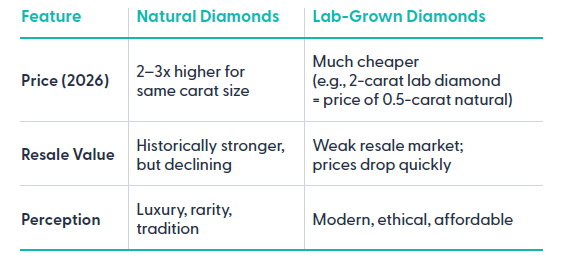
For retail investors, the message is clear: diamonds are no longer a reliable store of value. Lab-grown stones are best viewed as consumer products rather than investment assets, while natural diamonds face declining resale prospects as cultural and technological shifts reshape demand. Other commodities such as gold or platinum remain far more dependable for wealth preservation. In short, the sparkle of diamonds as an investment is fading, even if their allure as jewellery endures.
Times change, and with it, consumer choices. “Gentleman Prefer Blondes” is probably as unlikely to be the title of a new movie as real diamonds are to make a comeback.
1 Kimberlite is a rare type of igneous rock that is the primary source of natural diamonds. It forms deep within the Earth’s mantle and is brought to the surface through volcanic eruptions, often in pipe-like structures called diatremes. It is named after Kimberley (Northern Cape, South Africa), where the first kimberlite pipe was discovered.
Disclaimer
The information provided is of a general nature only and does not take into account investor’s objectives, financial situations or needs. The information does not constitute financial product advice and it should not be used, relied upon or treated as a substitute for specific, professional advice. It is, therefore, recommended that investors obtain the appropriate legal, tax, investment and/or other professional advice and formulate an investment strategy that would suit the investor’s risk profile prior to acting on such information and to consider whether any recommendation is appropriate considering the investor’s own objectives and particular needs. Although the information provided and statements of fact are obtained from sources that Analytics Consulting considers reliable, we do not guarantee their accuracy, completeness or currency and any such information may be incomplete or condensed. No guarantee of investment performance should be inferred from any of the information contained in this document. Collective Investment Schemes in Securities (“CIS”) are generally medium to long term investments. The value of participatory interests may go down as well as up and past performance is not necessarily a guide to future performance.
Any opinions, statements and information made available, whether written, oral or implied are expressed in good faith. Views are subject to change, without prior notice, on the basis of additional or new research, new facts or developments. All data is in base currency terms unless otherwise indicated, and sourced as disclosed.