

Monthly Market Overview – February 2026
March 12, 2026
PODCAST: Markets under Pressure
April 16, 2026Monthly Market Overview – February 2026
March 12, 2026PODCAST: Markets under Pressure
April 16, 2026NEWS
Monthly Market Overview
MARCH 2026 IN REVIEW
ECONOMIC AND MARKET OVERVIEW
March 2026 was another month marked by heightened geopolitical tension and cautious economic management across the Middle East, South Africa, Europe and Asia. The conflict in the Middle East dominated global attention as it intensified during March, with the US and Israel continuing coordinated strikes against Iranian military and nuclear facilities. Iran retaliated with missile and drone attacks across the region, while the Strait of Hormuz remained a persistent flashpoint. Shipping disruptions heightened investor concerns about energy security, contributing to continued volatility in global oil markets.
Strikes on Iran’s South Pars gas field and related facilities significantly reduced liquefied natural gas (LNG) output, with QatarEnergy reporting a loss of approximately 17% of its LNG capacity for up to five years. Restrictions on shipping through the Strait of Hormuz disrupted global flows of crude oil and refined fuel, creating uncertainty for Asian and European importers. These disruptions led to shortages of jet fuel, diesel and petrol across parts of Asia, with similar pressures expected to reach Europe by April.
Against this backdrop of geopolitical uncertainty, the South African Reserve Bank (SARB) held the repo rate steady at 6.75% in March, keeping the prime lending rate at 10.25%. Policymakers cited global instability and domestic inflation risks, signalling that while stability remains the priority, further rate hikes remain possible should higher imported fuel costs place upward pressure on inflation. South Africa’s flagship rapid rail system, the Gautrain, entered a new phase as the long-standing Bombela Concession Company agreement expired at the end of March. A new 15-year public-private partnership is in the process of being finalised, with the Bombela Operating Company managing operations on an interim basis. This transition underscores the importance of infrastructure continuity within Gauteng’s transport network.
European economies faced rising energy costs linked to the Middle East conflict, although trade flows remained resilient. Air-cargo demand increased, reflecting strong supply-chain activity despite ongoing geopolitical uncertainty. On the political front, discussions around security commitments in the Mediterranean and Eastern Europe highlighted the continent’s careful balancing act between trade priorities and defence considerations.
In Asia, governments closely monitored inflationary pressures as oil prices rose. Japan and South Korea emphasised energy diversification, while China continued to promote regional trade stability amid global disruptions. The Far East’s resilience in manufacturing and exports provided some counterbalance to volatility in energy markets.
March highlighted the intersection of war-driven energy risks and cautious monetary policy. Apart from higher fuel prices, South Africa remains, to a large extent, insulated from the more severe impacts of the conflict, while Europe and Asia grapple with external energy supply shocks. Globally, the US–Israel–Iran conflict remains the defining risk, shaping investor sentiment across markets.
MARKET PERFORMANCE
In March 2026, oil prices surged as the US–Israel–Iran conflict disrupted supply routes and damaged key energy infrastructure. Brent crude climbed above $100 per barrel, while the OPEC basket spiked to over $145, reflecting acute concerns about Middle Eastern output and the bottleneck at the Strait of Hormuz. These disruptions led to refined product shortages across Asia and threatened supplies to Europe, keeping global energy markets under sustained pressure.
Gold prices reflected the heightened geopolitical uncertainty, reinforcing the metal’s role as a safe‑haven asset. Prices rose sharply during the month, briefly jumping more than 5% to above $4 560 per ounce before settling near that level at month‑end. Volatility remained elevated, but the overall trend pointed to strong demand for security amid war‑driven instability and inflationary concerns. In South African rand terms, gold also strengthened, underscoring its value as a hedge against both global and
local risks.
Meanwhile, the US equity market struggled under the weight of geopolitical tensions and rising energy costs. The S&P 500 fell nearly 5% in March, marking its longest losing
streak in almost four years. Most index constituents declined, reflecting broadbased weakness. A late‑month rally provided some relief, driven by speculation that hostilities with Iran might ease, but overall investor sentiment remained cautious.
South African assets also performed poorly, with equities declining by 10.5%, led by a sharp fall in the Resources sector (‑16.5%). Local bonds sold off by 6.8%, recording their second‑largest monthly decline in over two decades. Together with the weakening of the rand (‑6.3% against the US dollar), this performance reinforced the market’s high‑beta reputation. Viewed from a balanced‑fund perspective, however, the first quarter of 2026 was far from disastrous. The average South African balanced fund recorded losses of between 1% and 2%, with many recovering some of these losses during the first few trading days of April.

Invest for the long term
“Keep calm and carry on” - British slogan during the Second World War1
It’s easy to fall into a trap of trying to predict the behaviour of the Trump administration. There are myriad experts, commentators, traders, journalists, analysts, (sofa) economists, influencers, TikTokkers and neighbours who are ready with an opinion on what the future will hold. In fact, if you’re lucky, they may have a second view, when the first one turns out not to materialise.
During volatile times, there are a few factors that South African investors should keep in mind. Surprisingly, none of these has to do with announcements from the Oval Office (or on Truth). It will be changes to the current trends of economic growth, inflation and interest rates that will influence the health of personal income statements and balance sheets.
Economic growth
The risk of a global recession has risen sharply on the back of sharply higher oil prices, which will have the most immediate economic impact affecting inflation and interest rates. Slower global growth increase risks to open economies (of which South Africa is one) where foreign trade represents about 60% of gross domestic product.
South Africa may be far from the fighting, but the impact will be felt through global energy markets. Oil and petroleum products account for nearly 18% of our imports, so shifts in international prices feed quickly into the domestic economy. When geopolitical tensions rise, markets build in a risk premium, pushing oil prices higher – especially when supply routes like the Strait of Hormuz are threatened.
For households and businesses, higher oil prices translate directly into higher fuel costs. Current conflict levels led to a significant petrol and diesel price increase in April alone (despite being subsidised by R3 a litre by the South African government). A prolonged or expanding war would mean even greater pain. Fuel costs act like a tax: consumers spend more on transport, while businesses face rising logistics and production expenses.
The result is slower growth and broader inflationary pressure. What begins as a spike in petrol and diesel prices eventually filters through the economy, raising costs across the board. In this war, South Africa would do well to import only the pain, and not the politics.
Inflation
One of the clearest knock‑on effects of higher oil prices is inflation. Before the Middle East conflict escalated, South Africa’s 2026 outlook looked manageable. But a sharp jump in petrol costs could push consumer inflation above 4% in April, compared with January’s forecast of 3.4%. On an annual basis, inflation may average closer to 4.2% versus earlier estimates of 3.3%. This doesn’t signal a long‑term problem, but it complicates the short‑term picture for monetary policy.
Interest rates
Earlier in the year, the expectation was that the South African Reserve Bank (SARB) would cut rates by about 75 basis points in 2026, starting in March and continuing at alternate Monetary Policy Committee (MPC) meetings. As it turns out, they kept rates unchanged at their last meeting. If oil prices remain high and inflation spikes, the
risk‑averse MPC will, however, likely delay cuts until the outlook is clearer. A quick easing of tensions could still open the door to rate reductions later in the year, while a prolonged conflict might even force hikes—though that risk remains low. Petrol shocks often prove deflationary over time, as households cut other spending and weaker
demand helps contain broader inflation. In the end, human grit and endeavour will find a way. Markets reach all-time highs because that is what they do – over the long term, they go up. There will be bumps along the way, as the graph below of the US equity market shows.
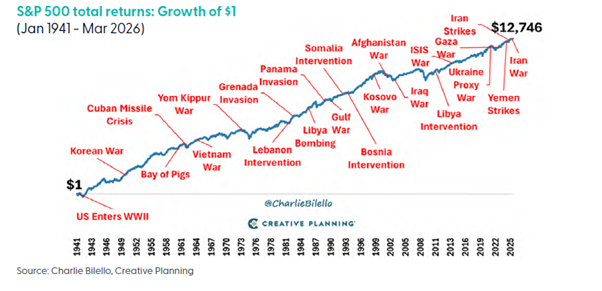
Patient investors have been rewarded for as long as we have history. So, for your own sanity, remember these guidelines:
• Keep Calm. Conflict causes short-term volatility, but it seldomly derails long-term economic trends.
• Carry On. If your investment strategy was solid before these geopolitical events, it is likely to remain your best way forward. A diversified portfolio is ideal to navigate situations like this.
• Hold Hands. Your trusted investment advisor has your back. Reactive changes, prompted by investors, very rarely adds value to long-term outcomes.
Lastly: the next time you chose to listen to a soliloquy (with humility in short supply) from an octogenarian with orange hair, remember that it’s time you’ll never get back.
1 The phrase “Keep Calm and Carry On” was first printed in Britain in 1939 as part of a series of morale‑boosting posters prepared for World War II. Unlike its sister slogans, it was held back for use only in the event of invasion or catastrophic defeat, and so it was barely seen during the war. Millions of copies sat in storage, forgotten until a single poster was rediscovered in a Northumberland bookshop in 2000. From there, it became a global phenomenon, reissued on mugs, T‑shirts, and countless parodies.
Disclaimer
The information provided is of a general nature only and does not take into account investor’s objectives, financial situations or needs. The information does not constitute financial product advice and it should not be used, relied upon or treated as a substitute for specific, professional advice. It is, therefore, recommended that investors obtain the appropriate legal, tax, investment and/or other professional advice and formulate an investment strategy that would suit the investor’s risk profile prior to acting on such information and to consider whether any recommendation is appropriate considering the investor’s own objectives and particular needs. Although the information provided and statements of fact are obtained from sources that Analytics Consulting considers reliable, we do not guarantee their accuracy, completeness or currency and any such information may be incomplete or condensed. No guarantee of investment performance should be inferred from any of the information contained in this document. Collective Investment Schemes in Securities (“CIS”) are generally medium to long term investments. The value of participatory interests may go down as well as up and past performance is not necessarily a guide to future performance.
Any opinions, statements and information made available, whether written, oral or implied are expressed in good faith. Views are subject to change, without prior notice, on the basis of additional or new research, new facts or developments. All data is in base currency terms unless otherwise indicated, and sourced as disclosed.