

Monthly Market Overview – December 2025
January 21, 2026
2026 BUDGET SPEECH – AE Investment Managers
March 2, 2026Monthly Market Overview – December 2025
January 21, 20262026 BUDGET SPEECH – AE Investment Managers
March 2, 2026NEWS
Monthly Market Overview
JANUARY 2026 IN REVIEW
ECONOMIC AND MARKET OVERVIEW
The Economist reported that Iran’s supreme leader, Ayatollah Ali Khamenei, warned America that an attack on his country would spark a “regional war,” even as officials signalled they would enter talks to try to avoid military action. Earlier, Donald Trump said Iran was “seriously talking” to America. He has sent significant naval forces to the region and threatened Iran with attack if it does not abandon its nuclear programme. Despite the hostile rhetoric, both sides still leave the door open for talks, though trust remains minimal. Gulf states and other global powers are urging restraint, fearing disruption to oil markets and regional stability.
President Trump threatened escalating tariffs (from 10% to 25%) on eight NATO countries unless Greenland is sold to the US. This sparked backlash from the European Union and led to the suspension of a trade deal. Markets reacted negatively, with US and European equities dipping amid heightened geopolitical risk.
The 56th World Economic Forum (WEF) meeting brought together over 60 heads of state and 3,000 participants. Key themes included geopolitical conflict, sovereign debt, AI risks, and declining trust. India showcased its largest-ever delegation, while President Trump’s remarks on Greenland dominated headlines.
The US President delivered a combative address, reiterating his demand that Denmark sell Greenland to the United States. He framed the territory as a strategic necessity, while highlighting US economic strength and downplaying European influence. Although he stated he would not use force, his rhetoric unsettled leaders and overshadowed broader WEF discussions.
Business leaders were left uncertain about the direction of US trade policy, while European officials viewed the remarks as destabilising. The speech underscored Trump’s preference for economic pressure over multilateral cooperation.
The South African Reserve Bank (SARB) kept the repo rate unchanged at 6.75%, following a split decision, with two of the six members favouring a 25bps cut. Inflation remains close to 3.6%, and the decision reflects continued caution amid global uncertainty and rand volatility.
Earlier in the month, at the World Economic Forum in Davos, SARB Governor Lesetja Kganyago indicated that the prime lending rate, long used as the benchmark for consumer loans, may soon be abolished as part of broader reforms to interest rate structures. The central bank’s view is that commercial banks already price loans according to borrower risk profiles, making the traditional “prime plus/ minus” framework increasingly redundant.
The International Monetary Fund upgraded its global GDP growth forecast for 2026 to 3.3%, up from 3.1%, citing strong investment in artificial intelligence, easing trade frictions, and supportive fiscal and monetary conditions. Inflation is expected to continue declining gradually, reaching 3.8% in 2026.
South Africa’s growth forecast was also revised slightly higher to 1.4%, although this remains below the level required to support meaningful job creation.
The US Federal Reserve held its benchmark interest rate steady at 3.5% to 3.75% at its 28 January meeting, pausing after three consecutive rate cuts in late 2025. Inflation remains “somewhat elevated,” with two members dissenting in favour of a cut. Markets are now pricing in the possibility of further easing later in 2026.
In late January 2026, US President Donald Trump nominated Kevin Warsh, a former Federal Reserve governor and economic adviser, to succeed Jerome Powell as Chair of the Federal Reserve. The nomination reflects Trump’s preference for lower interest rates and signals a significant shift in leadership at the world’s most influential central bank.
Chinese growth is projected to slow from 4.9% in 2025 to 4.4% in 2026, reflecting subdued domestic demand and ongoing structural headwinds. This deceleration is weighing on the broader East Asia and Pacific region, where growth is also expected to reach 4.4% in 2026. However, some Asian economies, including Vietnam, Indonesia and India are showing resilience, with policy support helping to offset weaker global trade.
MARKET PERFORMANCE
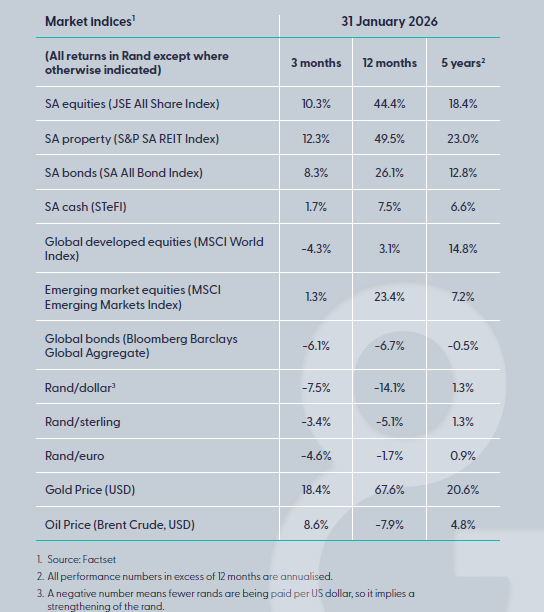
Global markets started the year strongly, showing little regard for the geopolitical turmoil during January. Developed market equities (as measured by the MSCI World Index) gained 2.3% in US dollar terms, while emerging markets clearly outperformed, delivering a robust 8.9% return for the month.
South African equities added 3.7% for the month, despite a sell-off of over 4% on the last trading day of January. Resources (+12.5%) led the charge and did more than enough to offset the performance of industrial stocks (-3.4%).
South African equities gained 3.7% for the month, despite a sell-off of more than 4% on the final trading day of January. The resources sector (+12.5%) led the gains and more than offset the weaker performance of industrial stocks (-3.4%).
South African bonds continued their consistent performance, gaining 1.9% for the month and recording their thirteenth positive monthly return. This marks the longest streak in over 26 years, supported by a firmer rand and growing investor confidence in improved fiscal outcomes from the South African government.
Gold prices surged in January 2026, climbing more than 25% during the month before retreating slightly at month end. The metal closed just over USD 5 000 per ounce internationally. The rand price of a fine ounce of gold peaked above R85 000, before closing the month a little over R80 000.
Silver also experienced a tumultuous month. It began the year at around USD 70 per fine ounce, rallied to approximately USD 116 on 28 January, and then pulled back to USD 84 by month-end.
War and Peace. And markets.
“Only the dead have seen the end of war.” - Plato
“All wars end in discussions.” - Dwight D Eisenhower, 34th president of the United States
Global internet access has grown from just a few million users in 1990 to around 5.6 billion in 2025, representing about three-quarters of the world’s
population. According to the United Nations Population Division1, fewer than 3 million people had access to the internet in 1990. This accounted for
0.05% of the global population at the time.
By the turn of the century this number grew to over 360 million people (6 in every 100) had access to the world wide web, and by 2010 approximately 1.9 billion humans (27%) could browse the net.
In 2025, seven out of ten people had access to immediate news (fake or not) from around the globe. This explosion of information means that investors have so much more to (seemingly) worry about. Every day there appears to be half a dozen events that are supposed to send markets in a tailspin, but yet, it doesn’t. It’s understandable that, among investors, there’s a clear unease about the current geopolitical environment. There is simply so much bad news around.
There is a silver lining though. While geopolitical events can cause market volatility, major bear markets have historically been driven by factors inherent to the economy and financial system.
In other words, when it comes to the kinds of bear markets that can derail their financial plans for several years, history suggests investors should fear recessions, interest rate shocks, financial crises, bubbles, and excessive debt more than conflict, as the graph of the US Equity market (1900 to 2025) illustrates below:

There are a few caveats. Obviously, the two World Wars caused massive devastation and dislocation. Even so, it mattered greatly which country you found yourself in.
Secondly, revolutions in which property rights were completely upended (Russia 1917, China 1949) wiped out portfolios. The same is true of hyperinflation, which sometimes follows war.
The third caveat is illustrated by markets in the 1970s. Conflict in the Middle East caused two oil shocks, a decade of stagflation, and negative real returns. However, the world was particularly dependent on oil in those days, while central banks also failed to keep a lid on inflation. An oil-driven global crisis is just less likely today since we use much less oil for each unit of GDP. Maybe the crisis of the future is about microchips and rare earths, instead of crude.
This is not to say that investors should be complacent. The point is just that geopolitical drama is good for headlines, but over the longer-term, portfolio returns tend to be driven by more mundane factors. Once again, it’s time in the markets, rather than timing the market, which will serve investors well in 2026.
Adapted (with the author’s permission) from a LinkedIn article by Izak Odendaal, Chief Investment Strategist, Symmetry.
Disclaimer
The information provided is of a general nature only and does not take into account investor’s objectives, financial situations or needs. The information does not constitute financial product advice and it should not be used, relied upon or treated as a substitute for specific, professional advice. It is, therefore, recommended that investors obtain the appropriate legal, tax, investment and/or other professional advice and formulate an investment strategy that would suit the investor’s risk profile prior to acting on such information and to consider whether any recommendation is appropriate considering the investor’s own objectives and particular needs. Although the information provided and statements of fact are obtained from sources that Analytics Consulting considers reliable, we do not guarantee their accuracy, completeness or currency and any such information may be incomplete or condensed. No guarantee of investment performance should be inferred from any of the information contained in this document. Collective Investment Schemes in Securities (“CIS”) are generally medium to long term investments. The value of participatory interests may go down as well as up and past performance is not necessarily a guide to future performance.
Any opinions, statements and information made available, whether written, oral or implied are expressed in good faith. Views are subject to change, without prior notice, on the basis of additional or new research, new facts or developments. All data is in base currency terms unless otherwise indicated, and sourced as disclosed.