
PODCAST | Credit Rating Update on South Africa
December 29, 2025
Monthly Market Overview – January 2026
February 17, 2026PODCAST | Credit Rating Update on South Africa
December 29, 2025Monthly Market Overview – January 2026
February 17, 2026NEWS
Monthly Market Overview
DECEMBER 2025 IN REVIEW
ECONOMIC AND MARKET OVERVIEW
The United States reached tariff agreements with several trading partners, easing concerns about trade fragmentation and stabilising supply chains. On the
3rd of January, however, the United States military intervened in Venezuela, under “Operation Absolute Resolve”. It involved large-scale strikes in Caracas and northern Venezuela, culminating in the capture of President Nicolás Maduro and his wife, Cilia Flores, who were flown to the United States to face criminal charges. This action by the Trump administration, under the eyes of a weakening United Nations, does not bode well for world peace.
COP30 (The 30th Conference of the Parties), held in Belém, Brazil in December 2025, focused on adaptation financing, just transition frameworks, and climate resilience. While it reinforced global cooperation, it fell short of delivering binding agreements on fossil fuel phase-outs and deforestation.
European governments wrestled with fiscal pressures amid weak industrial output and energy fragility.On the investment front, Norway’s sovereign wealth fund discussions highlighted a clash between ensuring its massive size secures future generations (long-term sustainability) and the government’s increasing reliance on fund withdrawals to cover rising public spending (especially for non-oil needs like Ukraine aid). This created tension with fiscal rules and the fund’s countercyclical role, complicated by new ESG mandates and green transition pressures. The core conflict involves balancing prudent saving for tomorrow with spending today, managing large market volatility, and integrating climate goals without hindering necessary investments or causing capital flight. This USD2 trillion is not alone in its struggle with these issues as many “green” and “activist investing” mandates delivered mediocre performance over the last few years.
The Institute of Strategic Risk Management reported that Sudan’s conflict was worsening, adding to security concerns in East Africa. The Sudan conflict
remains one of the world’s worst humanitarian crises as of January 2026, with escalating violence in Darfur and Kordofan, widespread drone strikes on civilians, and a health system on the brink of collapse. Nearly 1 900 people have been killed in the latest attacks on health facilities, and over 33 million Sudanese now require humanitarian aid.
Debates over frozen Russian assets and energy security dominated discussions in Europe.As it stands, Ukraine–Russia peace talks remain fragile and inconclusive. While diplomatic activity has intensified, Russia shows little willingness to make concessions, and analysts warn the war is unlikely to end in 2026. However, progress has been made on security guarantees for Ukraine, with the US, France, and the UK pledging support if a ceasefire is reached.
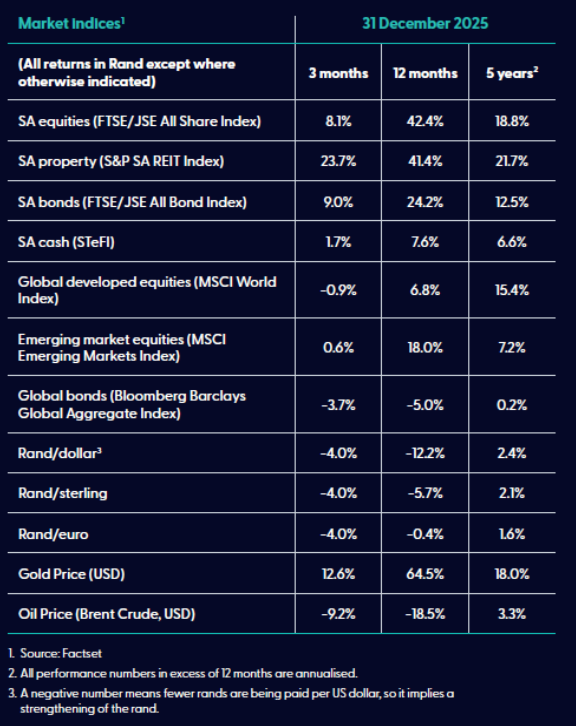
December was a significant month for South Africa’s macroeconomic landscape. The country recorded stronger GDP growth, exited the FATF grey list, received its first sovereign credit rating upgrade in two decades, and capped the year with a surge in vehicle sales and improved investor sentiment. Equity and bond markets delivered outsized returns in rands, and even more so when measured in US Dollars. Here’s wishing this sets the tone for 2026.
MARKET PERFORMANCE
December saw a more cautious tone across global markets, with investors weighing trade resets, fiscal debates, and geopolitical volatility against signs of resilience in climate diplomacy and emerging market reforms. While developed markets held steady, regional conflicts and political shifts underscored the fragility of the global backdrop heading into 2026.
In the United States, equity markets were broadly stable as tariff agreements with key trading partners eased supply chain concerns. However, fiscal brinkmanship around the debt ceiling and polarised domestic politics continued to weigh on sentiment. Treasury yields remained volatile, reflecting investor unease over long term fiscal sustainability.
European markets were subdued, with industrial weakness and fiscal strains limiting upside. Debates around sovereign wealth fund allocations highlighted tensions between sustainability and short-term fiscal needs. The EUROSTOXX 50 ended the month 2.3% higher, while energy-linked stocks provided modest support.
South Africa’s FTSE/JSE All Share Index rose 4.6%, supported by stable inflation and policy credibility. Local bonds gained modestly, reflecting investor confidence in fiscal management. Currency markets were steady, with the Rand broadly stronger against major peers.
Commodities were mixed: gold ended 2.5% higher on safe-haven demand, while Brent crude softened nearly 4% amid supply adjustments. Platinum remained supported by industrial demand and constrained supply.
What are you looking at (so often)?
“In investing, what is comfortable is rarely profitable. Patience and discipline, not constant monitoring, are the real edge.”
- Attributed to many authors

In his 2001 book, Fooled by Randomness, Nicolas Taleb tells a story about an overzealous dentist who invests in the stock market but cannot resist checking his portfolio constantly. Taleb explains that if the dentist looks at his investments every minute or hour, he will see almost as many losses as gains, because short term fluctuations are dominated by noise. The frequent exposure to losses makes the experience feel painful and discouraging, even though the long term trend is positive.
A portfolio of securities is almost as likely to lose money over one trading day as it is gaining value in a day (about 46% versus 54%). Over a month this changes to a 38% chance of seeing a loss, and a 62% chance of seeing a gain.
Taleb contrasts this with the same dentist checking his portfolio only once a year. Over that horizon, the probability of seeing gains is much higher (between 70 and 80%, depending on the equity markets the portfolio is invested in), and the investor feels rewarded rather than punished. The flip side is that the probability to see losses falls to below 30%. To add to this, a “down year” is more often than not followed by solid positive returns.
The lesson is simple but powerful: the more often you monitor investments, the more randomness you see, and the more likely you are to react emotionally to short term losses. By stepping back and focusing on longer horizons, investors align their perception with reality — equities tend to rise over time, but patience and discipline are required to benefit from that drift.
Disclaimer
The information provided is of a general nature only and does not take into account investor’s objectives, financial situations or needs. The information does not constitute financial product advice and it should not be used, relied upon or treated as a substitute for specific, professional advice. It is, therefore, recommended that investors obtain the appropriate legal, tax, investment and/or other professional advice and formulate an investment strategy that would suit the investor’s risk profile prior to acting on such information and to consider whether any recommendation is appropriate considering the investor’s own objectives and particular needs. Although the information provided and statements of fact are obtained from sources that Analytics Consulting considers reliable, we do not guarantee their accuracy, completeness or currency and any such information may be incomplete or condensed. No guarantee of investment performance should be inferred from any of the information contained in this document. Collective Investment Schemes in Securities (“CIS”) are generally medium to long term investments. The value of participatory interests may go down as well as up and past performance is not necessarily a guide to future performance.
Any opinions, statements and information made available, whether written, oral or implied are expressed in good faith. Views are subject to change, without prior notice, on the basis of additional or new research, new facts or developments. All data is in base currency terms unless otherwise indicated, and sourced as disclosed.