

Infomercial | The Power of Compounding
October 23, 2025
Monthly Market Overview – October 2025
November 17, 2025Infomercial | The Power of Compounding
October 23, 2025Monthly Market Overview – October 2025
November 17, 2025NEWS
Monthly Market Overview
SEPTEMBER 2025 IN REVIEW
ECONOMIC AND MARKET OVERVIEW
The Federal Reserve approved its first interest rate cut of the year, lowering the federal funds rate by 25 basis points to a target range of 4.00% – 4.25%. The decision, supported by all but one voting member, reflected growing concern over a softening labour market and persistent inflation. Chair Jerome Powell described the move as “risk management,” citing elevated downside risks to employment. The Fed signalled two further cuts before year-end, though uncertainty remains high amid a government shutdown that has delayed key economic
data releases.
The South African Reserve Bank (SARB) held its repo rate steady at 7.00%, pausing after two consecutive cuts earlier in the year. Governor Lesetja Kganyago noted that while second-quarter GDP surprised to the upside, inflation risks—particularly from electricity and food—remain elevated. The SARB reaffirmed its commitment to anchoring inflation at the lower end of its 3–6% target range, with the preferred level now set at 3%. The decision was split, with four members voting to hold and two favouring another cut.
President Donald Trump made an unprecedented second state visit to the United Kingdom from 16–18 September. Hosted by King Charles III at Windsor Castle, the visit featured ceremonial pageantry including a carriage procession, military flypast, and a state banquet. Trump met Prime Minister Keir Starmer at Chequers, where they discussed trade, immigration, and foreign policy. The visit also marked the launch of a US–UK technology-focused partnership focused on AI, quantum computing, and rare earth minerals
South Africa’s trade delegation, led by President Cyril Ramaphosa and Minister Parks Tau, visited the United States to strengthen bilateral ties. The delegation participated in the SA–USA Trade and Investment Dialogue in New York and held talks with US Trade Representative Ambassador Jamieson Greer. Key topics included market access, investment promotion, and trade facilitation. The visit coincided with the UN General Assembly, where Ramaphosa reiterated calls for multilateral reform and inclusive global governance.
In China, economic policy remained expansionary amid continued pressure on growth. The People’s Bank of China injected liquidity via medium-term lending facilities and reduced reserve requirements for select banks. Meanwhile, Beijing accelerated disbursement of previously announced infrastructure bonds and signalled further fiscal support for local governments. Despite these measures, property sector weakness and subdued consumer sentiment continue to weigh on recovery prospects.
The US government shut down on 1 October 2025, because Congress failed to pass a funding bill for the 2026 fiscal year due to deep partisan disagreements. The core issues were proposed cuts to Medicaid and the expiration of Affordable Care Act subsidies. Democrats demanded the reversal of those cuts and an extension of the subsidies as part of the funding package, while Republicans – who control both chambers – insisted those matters be handled separately. With neither side willing to compromise, the previous continuing resolution expired, triggering the shutdown.
MARKET PERFORMANCE
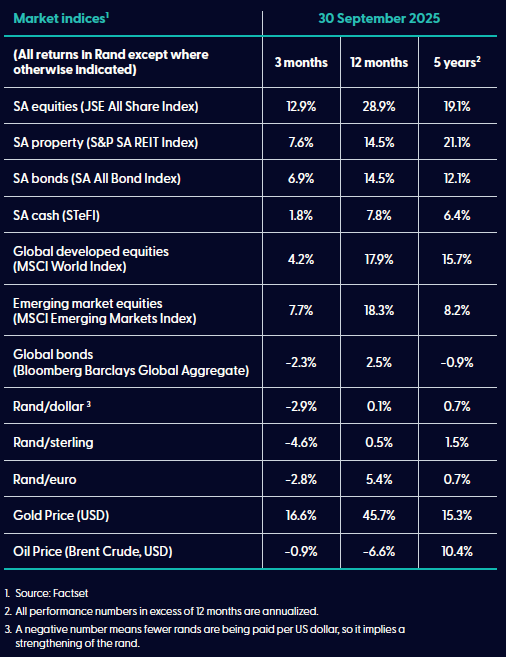
Global equity markets extended their gains in September, supported by resilient technology earnings, dollar weakness, and growing optimism around AI-driven partnerships. The MSCI All Country World Index (ACWI) rose 3.6%, with emerging markets (+7.2%) outperforming developed peers (+3.2%) by some margin.
The S&P 500 gained 3.7%, led by the “Magnificent 7” mega[1]cap tech stocks which surged on news of major AI investments and chip deals. Nvidia’s USD100 billion commitment to OpenAI infrastructure was a standout. The NASDAQ mirrored this strength, while the Russell 2000 rose 3.1%, supported by easing financial conditions and renewed interest in small-cap mergers and acquisitions.
In Europe, the EUROSTOXX 50 gained 3.4%, as investors weighed fiscal concerns against stable European Central Bank policy and improving inflation dynamics. The UK’s FTSE 100 rose 1.8%, buoyed by commodity-linked sectors and tariff negotiations that favoured domestic producers. Japan’s Nikkei 225 led developed markets with a 5.7% gain, driven by corporate governance reforms, strong foreign inflows and a weaker Yen.
South Africa’s JSE All Share Index gained 6.6%, with resources (+25.5%) leading the charge. Financials (-1.9%) and Industrials (+1.3%) did not participate in the rally to any extent. Local bonds added 3.4%, supported by stable rates, favourable inflation signals and foreign buying.
Gold rose a massive 10.6% to over USD3 800/oz, continuing upwards in the face of geo-political instability, while brent crude oil pulled back a little to USD67.59/barrel. The price of platinum surpassed the USD1 600 per ounce mark by the end of the month, reaching a 12-year high amid persistent supply deficits and rising investment demand.
How to invest if you want to be cheerful
“Money can't buy happiness, but it can buy a yacht to sail right up next to it” - David Lee Roth
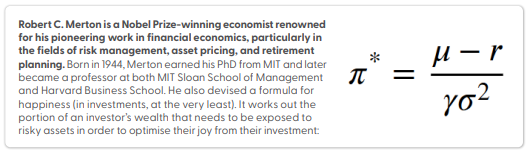
Without delving into the detail, the formula of “Merton’s share”, it concludes that happiness is maximised when individuals:
- Allocate their wealth optimally between risky assets (like equities) and risk-free assets (like bonds or money market instruments)
- Consume at a rate that balances current enjoyment with future security.
- Adjust decisions dynamically as time and wealth evolve.
In short, investment happiness comes with the in-depth study of mathematics, statistics, probability theory, behavioural psychology and a few other scientific disciplines. Or, you can speak to your financial adviser. You choose.
π* = Portion of wealth to invest in risky assets | µ = expected return of the risky asset | r = the risk free rate | γ = risk aversion coefficient
σ = volatility of the risky asset
Disclaimer
The information provided is of a general nature only and does not take into account investor’s objectives, financial situations or needs. The information does not constitute financial product advice and it should not be used, relied upon or treated as a substitute for specific, professional advice. It is, therefore, recommended that investors obtain the appropriate legal, tax, investment and/or other professional advice and formulate an investment strategy that would suit the investor’s risk profile prior to acting on such information and to consider whether any recommendation is appropriate considering the investor’s own objectives and particular needs. Although the information provided and statements of fact are obtained from sources that Analytics Consulting considers reliable, we do not guarantee their accuracy, completeness or currency and any such information may be incomplete or condensed. No guarantee of investment performance should be inferred from any of the information contained in this document. Collective Investment Schemes in Securities (“CIS”) are generally medium to long term investments. The value of participatory interests may go down as well as up and past performance is not necessarily a guide to future performance.
Any opinions, statements and information made available, whether written, oral or implied are expressed in good faith. Views are subject to change, without prior notice, on the basis of additional or new research, new facts or developments. All data is in base currency terms unless otherwise indicated, and sourced as disclosed.