

Monthly Market Overview – September 2025
October 23, 2025
Monthly Market Overview – November 2025
December 18, 2025Monthly Market Overview – September 2025
October 23, 2025Monthly Market Overview – November 2025
December 18, 2025NEWS
Monthly Market Overview
OCTOBER 2025 IN REVIEW
ECONOMIC AND MARKET OVERVIEW
The International Monetary Fund maintained its global growth forecast at 3.1% for 2025, noting that the temporary factors supporting earlier activity - such as front-loading and inventory restocking - were fading. Inflationary pressures continued to ease, but trade remained subdued and currency markets volatile.
Economic data releases in the United States were disrupted by an ongoing government shutdown, creating a “data blackout” that clouded market visibility. Nonetheless, core CPI inflation slowed to 3.0% in September, suggesting gradual progress against price pressures. Equity markets advanced modestly, buoyed by expectations of further interest rates cuts by the Federal Reserve.
Europe continues to face fiscal uncertainty and political fragmentation, with tight budget constraint and upcoming elections contributing to heightened policy volatility. Industrial production remained weak, and leadership changes in several EU states signalled potential market disruptions.
China’s economy showed signs of stabilisation, supported by liquidity injections and accelerated infrastructure spending. However, concerns over
property sector fragility and consumer sentiment persisted. Other emerging markets saw mixed performance, with commodity exporters benefiting from price rebounds.
October marked another anniversary of the Israel- Hamas conflict, prompting increased extremist propaganda and heightened security alerts across the Middle East, North Africa, and parts of Europe. A positive development was the US-brokered ceasefire in the Gaza Strip that took effect on 10 October 2025, which aimed to halt hostilities and facilitate humanitarian relief and prisoner exchanges. While the truce has led to some progress, violations and tensions persist.
Conflicts intensified in both Ukraine and Sudan, with renewed fighting in eastern Ukraine and escalating violence in Sudan’s Darfur region. These developments
added to global security concerns and disrupted regional supply chains.
Legislative elections in Czechia saw the populist ANO party, led by Andrej Babiš, emerge as the likely coalition leader. The potential inclusion of far-right parties in government raised eyebrows across the EU.
South Africa officially exited the Financial Action Task Force (FATF) grey list on 24 October 2025, following nearly three years of reform efforts to address deficiencies in anti-money laundering and counterterrorist financing frameworks.
MARKET PERFORMANCE
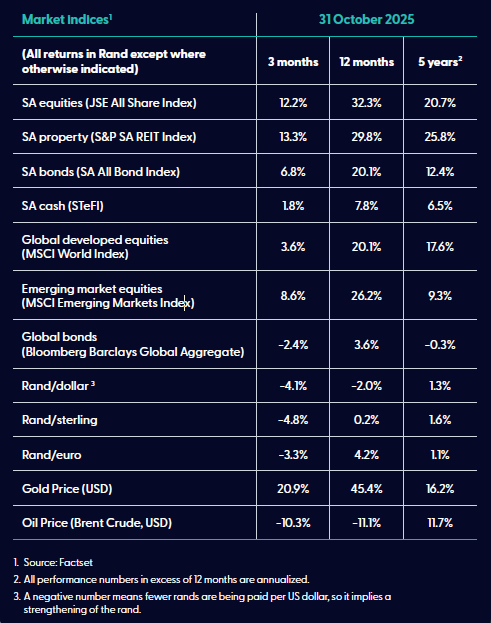
October saw mixed performance across global equity markets, with tech-heavy indices rebounding, Japan outperforming, and emerging markets lagging. Investor sentiment was shaped by stabilising inflation, cautious central bank policy, and geopolitical crosscurrents.
In the U.S., the S&P 500 gained 2.3% while the NASDAQ gained 4.8%, buoyed by resilient corporate earnings and renewed enthusiasm for AI and cloud computing. Lower bond yields supported tech valuations, although broader market gains were tempered by uncertainty around future rate guidance. Japan’s Nikkei 225 surged 16.7%, driven by robust export data and a weaker yen that boosted corporate profits. Meanwhile, the FTSE 100 in the UK gained 4.1%.
South Africa’s FTSE/JSE All Share Index rose 1.6%, supported by improved investor confidence following the country’s exit from the FATF grey list and a stable interest rate environment. The South African Reserve Bank held the repo rate at 7% at its September MPC meeting, citing subdued inflation and global disinflationary trends. This policy stability, combined with rising public-sector infrastructure investment, helped lift domestic sentiment.
Emerging markets remained under pressure, with the MSCI Emerging Markets Index (up 2.0%) slightly underperforming developed peers (up 2.3%). Uneven recovery in China and geopolitical tensions weighed on returns, although select Latin American markets showed resilience.
Looking ahead, investors remain focused on central bank signals, earnings momentum, and the evolving macro backdrop. Portfolio positioning continues to favour quality and defensiveness, with selective opportunities in infrastructure, energy transition, and tech innovation.
What doesn’t kill you makes you stronger
“The King is dead. Long live the King.” - Traditional expression
Much has been said about the shrinking opportunity set of equity investments on the African continents largest stock market - the JSE.
First, some history. The Johannesburg Stock Exchange (JSE) was founded on 8 November 1887 during South Africa’s first gold rush and has since evolved into Africa’s largest and most sophisticated stock exchange. It was established by Benjamin Minors Wollan to facilitate trade in mining shares following the discovery of gold in the Witwatersrand in 1886. The trading in the early days took place in a miner’s tent and then moved to stables at the corner of Saur and Commissioner Streets in Johannesburg. The first company to list was Johannesburg Chambers and Company, Wollan’s own firm. The JSE joined the World Federation of Exchanges in 1963, marking its growing international stature.
It transitioned to an electronic trading system in the early 1990s, replacing the open outcry method. It also acquired the South African Futures Exchange (SAFEX) in 2001 and the Bond Exchange of South Africa (BESA) in 2009, expanding its product offerings. In 2003, it launched AltX, an alternative exchange for small and mid-sized companies, followed by Yield X for interest rate and currency instruments. The JSE demutualised and listed on its own exchange in 2005, becoming a public company and enhancing transparency and governance. It now offers five financial markets: Equities, Bonds, Financial Derivatives, Commodity Derivatives, and Interest Rate Derivatives.
From a peak of 669 listings in 1998, the JSE has seen a decline of over 50% in the number of companies on the bourse, with fewer than 270 companies currently listed. Of these, fewer than 150 are realistically investable by fund managers with any significant size of assets to manage.
This reduction in number of listed companies is attributed to factors such as increased regulatory costs, challenging economic conditions
in South Africa, and strategic moves by companies to pursue delisting in favour of private equity opportunities.
What has happened in the process, however, is that many companies were bought out by other entities, so that the companies that remain are typically stronger and more sustainable than the majority that have delisted.
Secondly, by another measure, the JSE has actually grown. The graph below shows how the total aggregate revenue per share on the JSE since the start of this century.
Aggregate Total Revenue (per share basis) Growth for JSE All Share Index Through Time (Gross and Real):
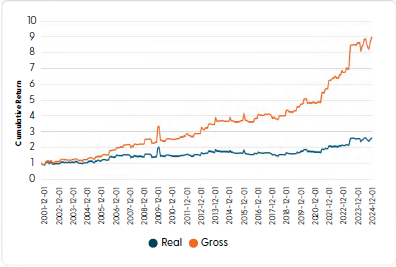
The number of shares may be less, but the quality is arguably better, and there’s more revenue to go around. Happy investing!
Disclaimer
The information provided is of a general nature only and does not take into account investor’s objectives, financial situations or needs. The information does not constitute financial product advice and it should not be used, relied upon or treated as a substitute for specific, professional advice. It is, therefore, recommended that investors obtain the appropriate legal, tax, investment and/or other professional advice and formulate an investment strategy that would suit the investor’s risk profile prior to acting on such information and to consider whether any recommendation is appropriate considering the investor’s own objectives and particular needs. Although the information provided and statements of fact are obtained from sources that Analytics Consulting considers reliable, we do not guarantee their accuracy, completeness or currency and any such information may be incomplete or condensed. No guarantee of investment performance should be inferred from any of the information contained in this document. Collective Investment Schemes in Securities (“CIS”) are generally medium to long term investments. The value of participatory interests may go down as well as up and past performance is not necessarily a guide to future performance.
Any opinions, statements and information made available, whether written, oral or implied are expressed in good faith. Views are subject to change, without prior notice, on the basis of additional or new research, new facts or developments. All data is in base currency terms unless otherwise indicated, and sourced as disclosed.