

Monthly Market Overview – October 2025
November 17, 2025
PODCAST | Credit Rating Update on South Africa
December 29, 2025Monthly Market Overview – October 2025
November 17, 2025PODCAST | Credit Rating Update on South Africa
December 29, 2025NEWS
Monthly Market Overview
NOVEMBER 2025 IN REVIEW
ECONOMIC AND MARKET OVERVIEW
The G20 summit in Johannesburg during November placed Africa at the centre of global economic dialogue, despite being snubbed by President Trump.
Leaders focused on inclusive growth, climate resilience, and reform of multilateral institutions, with South Africa championing debt relief for developing economies and greater representation in global governance. The summit produced commitments to expand renewable energy financing and strengthen supply chains for critical minerals, while also highlighting divisions between advanced and emerging economies on trade and fiscal policy.
Chancellor Rachel Reeves presented the UK’s Autumn Budget, balancing fiscal consolidation with targeted growth measures.
Modest tax increases on high earners were paired with incentives for green investment and additional NHS funding. Markets welcomed the budget’s credibility, with gilt yields stabilising after months of volatility. Concerns remain about productivity growth and the impact of tighter immigration policies on labour supply, but the budget reinforced fiscal discipline, while cautiously supporting demand.
The United States narrowly avoided breaching the debt ceiling in late November after weeks of political brinkmanship. A short-term extension was passed, calming markets, although Treasury yields spiked temporarily amid investor unease. Rating agencies warned that repeated standoffs could undermine confidence in US debt as the global safe asset. The episode underscored structural risks in US governance and fiscal sustainability.
In November Japan reported stronger-than-expected Q3 GDP growth, driven by exports and corporate investment, while South Korea unveiled a semiconductor innovation package to maintain global competitiveness. Regional trade flows showed signs of recovery, despite geopolitical tensions in the South China Sea continuing to be a drag on sentiment.
Diplomatic momentum gathered in November around a potential peace framework for Ukraine. Mediated by Turkey, and supported by the EU, the plan proposed phased territorial negotiations, security guarantees, and reconstruction funding tied to compliance. While both Kyiv and Moscow expressed cautious interest, significant hurdles remain—particularly around sovereignty and NATO alignment. Markets responded with guarded optimism, as energy prices eased slightly on hopes of reduced conflict driven supply risks.
The World Bank approved a USD 925 million (nearly R16 billion) loan for SA to support a six-year program to revive its major cities, including water and electricity supply improvement, as well as waste collection. The loan will help reward cities that meet operational and financial performance targets for urban services with additional funding and will cover eight cities, including Johannesburg and Cape Town, that generate 85% of SA’s economic output and are home to more than a third of its 63 million people.
South Africa’s Minister of Finance, Enoch Godongwana, tabled the Medium Term Budget Policy Statement (MTBPS). As anticipated, both the SARB governor and the finance minister announced that the official inflation target will now be set at 3%, changing from the previous target range of 3% to 6%. In addition to this positive sentiment, the SARB Monetary Policy Committee (MPC) unanimously voted to reduce the interest rate by another 25 basis points, with the market anticipating at least two more rate cuts during 2026.
MARKET PERFORMANCE
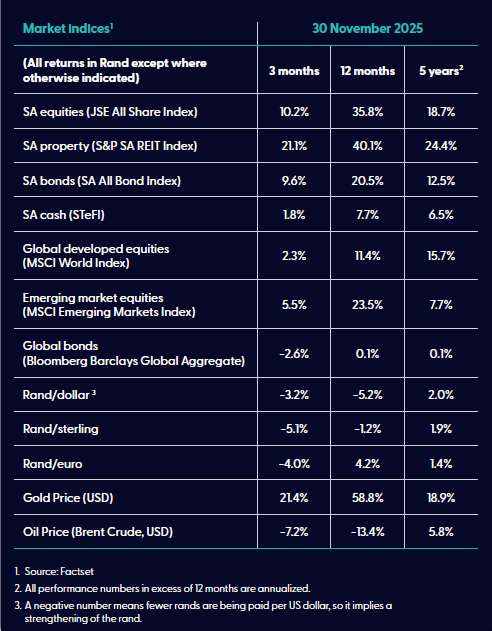
Global equity markets paused in November, consolidating the strong momentum evident since Liberation Day. Investor sentiment was shaped by robust US earnings, concerns over elevated valuations, and rotation into defensive sectors. Political developments, including the conclusion of the US government shutdown, added to the cautious tone, while local markets benefited from supportive fiscal and monetary policy signals.
In the US, the S&P 500 gained 1.5% and the NASDAQ rose 2.1%, buoyed by resilient earnings in technology and semiconductors. Lower bond yields provided valuation support, though broader gains were tempered by political uncertainty around fiscal sustainability. Small caps underperformed, with the Russell 2000 slipping marginally, reflecting tighter credit conditions. Overall, developed market equities were flat, with the MSCI World Index up 0.3% in USD, while emerging markets lagged, as the MSCI Emerging Markets Index contracted 2.4%.
South Africa’s FTSE/JSE All Share Index rose 1.7%, supported by favourable policy developments. The Medium Term Budget Policy Statement (MTBPS) reinforced fiscal credibility, while the SARB’s decision to lower the inflation target to 3% and cut rates by 25 basis points boosted confidence. Resources led the way (+9.6%), Financials edged higher (+1.8%), while Industrials detracted sharply (-4.8%). Property markets posted another strong month, with the ALPI up 7.7% and the S&P SA REIT Index gaining 9.2%. Local bonds rallied, with nominal bonds up 3.4% and inflation-linked bonds up 4.0%, reflecting improved sentiment post MTBPS.
Currency markets saw the Rand strengthen against major peers, appreciating 1.2% versus the US Dollar, 0.6% against the Euro, and 0.3% against the Pound Sterling. Commodities were mixed: Platinum (+6.9%) and Gold (+5.9%) rebounded strongly, while Brent crude declined 2.9% on supply adjustments and softer demand signals.
Another bubble, another burst
“In 1636, the Dutch traded futures on flowers, and for a brief, mad season, tulips were worth more than houses.”
- Charles Mackay, Scottish Author, 1841

The Tulip Mania (1634–1637) is widely regarded as the first recorded speculative bubble in history. At its peak, rare bulbs like Semper Augustus sold for the price of a canal house in Amsterdam. In February 1637, demand evaporated. Buyers failed to appear at routine bulb auctions, and confidence collapsed. Prices fell by more than 90% within weeks, leaving many speculators holding contracts for bulbs worth a fraction of what they had paid.
Since this OG1 of bubble there have been many more. A few have burst all over the globe, with many localised bubbles occurring across hundreds of countries.
More recently, a lot of questions have been raised about the rapid increase in share prices of the hyperscalers2 of the Artificial Intelligence (AI) world. As Amazon, Google, Microsoft, Meta and Oracle ramp up capital expenditure (capex) on primarily AI data centres, a lot of investors (and speculators) are asking: Is this the next tech bubble? But a striking divergence from past tech booms is emerging. Rather than a speculative bubble, this surge is anchored in solid fundamentals and reflects a durable transformation led by these hyperscalers.
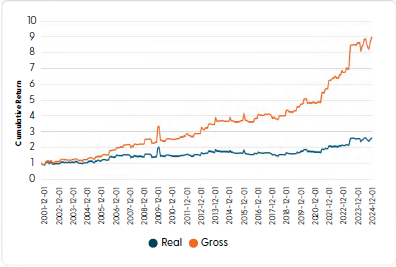
As Jennison Associates, a US based global equity manager, illustrates on the chart below, capital expenditure (capex), primarily on AI data centres, is surging. However, rather than signalling a repeat of the 2000 tech bubble (where a lot of the expansion was funded by debt), the chart shows big tech’s cash engines remain robust, their operating cash flow remaining positive and a projected 2027 moderation depends on AI monetisation delivering real returns. So, while the headline capex numbers appear enormous and spark talk of bubbles, the fundamentals look far stronger than past tech manias.
Source: Jennison Associates 31 October 2025
If it’s a bubble, it will burst. In the meantime, all indications are that it’s not. There will be individual winners and losers, but a partnership with a trusted investment adviser and a well thought-out, diversified investment strategy should help market participants navigate these turbulent waters.
1Original Gangsta (gangster)
2Hyperscalers in AI are the large technology companies (like Amazon Web Services (AWS), Microsoft, Google, and Meta) that operate massive cloud and data centre infrastructures, enabling artificial intelligence models to be trained, deployed, and scaled globally
Disclaimer
The information provided is of a general nature only and does not take into account investor’s objectives, financial situations or needs. The information does not constitute financial product advice and it should not be used, relied upon or treated as a substitute for specific, professional advice. It is, therefore, recommended that investors obtain the appropriate legal, tax, investment and/or other professional advice and formulate an investment strategy that would suit the investor’s risk profile prior to acting on such information and to consider whether any recommendation is appropriate considering the investor’s own objectives and particular needs. Although the information provided and statements of fact are obtained from sources that Analytics Consulting considers reliable, we do not guarantee their accuracy, completeness or currency and any such information may be incomplete or condensed. No guarantee of investment performance should be inferred from any of the information contained in this document. Collective Investment Schemes in Securities (“CIS”) are generally medium to long term investments. The value of participatory interests may go down as well as up and past performance is not necessarily a guide to future performance.
Any opinions, statements and information made available, whether written, oral or implied are expressed in good faith. Views are subject to change, without prior notice, on the basis of additional or new research, new facts or developments. All data is in base currency terms unless otherwise indicated, and sourced as disclosed.