

Monthly Market Overview – May 2026
June 12, 2026Monthly Market Overview – July 2026
August 20, 2026Monthly Market Overview – May 2026
June 12, 2026Monthly Market Overview – July 2026
August 20, 2026NEWS
Monthly Market Overview
JUNE 2026 IN REVIEW
ECONOMIC AND MARKET OVERVIEW
Tensions in the Middle East dominated global headlines during the month of June. Following period of heightened conflict involving Iran, Israel, and the United States, markets were relieved by reports of a ceasefire agreement and the reopening of key shipping routes through the Strait of Hormuz. While energy markets stabilised towards month-end, investors remain concerned that the region could be a source of volatility for some time.
The World Bank reduced its expectations for global economic growth, warning that higher energy prices, persistent geopolitical tensions, and slower trade growth continue to act as headwinds for the global economy. The institution highlighted that growth remains uneven across regions, with several emerging economies expected to outperform developed markets over the medium term.
Oil prices remained a key focus for investors. Although prices retreated from their highs due to signs of progress in Middle East negotiations, energy markets continue to price in the possibility of supply disruptions. Elevated oil prices remain one of the primary risks to the global inflation outlook.
Central banks continued to tread carefully. The US Federal Reserve maintained a cautious stance as inflation remained above target, while both the European Central Bank and the Bank of Japan continued with gradual policy normalisation. Divergences in monetary policy expectations remain an important driver of currency and bond market movements.
Artificial intelligence (AI) remains one of the major investment themes globally. Continued investment in AI infrastructure and technology exports provided support to economic activity, particularly in the United States and parts of Asia, helping to offset some of the weakness associated with slower global growth.
Concerns about government finances remain prominent in several developed economies. Investors continue to demand higher yields on long-dated government bonds as they assess fiscal sustainability, inflation risks, and the longer-term consequences of elevated government debt levels.
Closer to home, South Africa continues to benefit from a more stable electricity environment than was experienced during the peak years of load shedding. However, weak economic growth, logistical constraints, and ongoing fiscal pressures remain significant obstacles to the country achieving the higher growth rates required to address unemployment and improve living standards.
MARKET PERFORMANCE
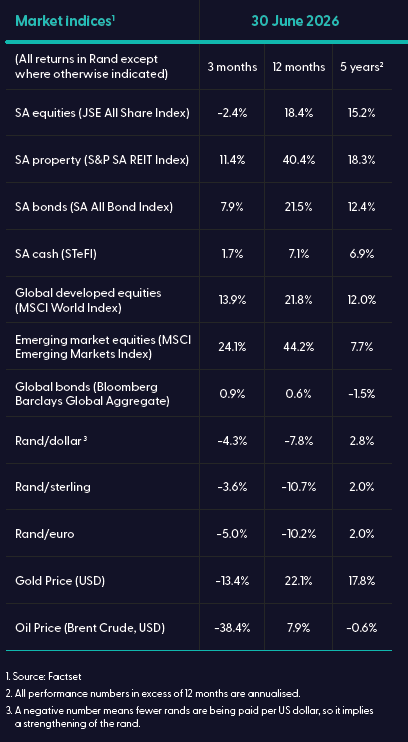
Global equity markets produced mixed results, as investors weighed easing geopolitical tensions in the Middle East against concerns that higher energy prices could prolong the battle against inflation. In the United States, the broad S&P 500 Index ended the month 1.1% lower, while the technology-heavy Nasdaq Composite retreated 2.8% as investors took profits following a strong first half of the year. Smaller-company shares fared better, with the Russell 2000 advancing 3.6% (all measured in US dollars). Despite the monthly pullback, US equities remain well ahead for the year, supported by resilient corporate earnings growth and continued enthusiasm surrounding AI-related investment.
European markets were more resilient. The UK's FTSE 100 gained 1.0%, and the Euro Stoxx 50 added 4.7% during the month. Japan continued to be one of the strongest performing major markets globally, with the Nikkei 225 surging 5.6% in local currency terms during June. Emerging markets struggled, however, with the MSCI Emerging Markets Index declining 1.4% as ongoing concerns surrounding Chinese growth and global trade weighed on sentiment.
South African markets endured a more difficult month. The JSE All Share Index declined 3.7%, with resource shares particularly weak as commodity prices and global growth expectations softened. Financial shares provided some support but were unable to offset weakness elsewhere in the market. Local bonds delivered a stronger performance as investors responded favourably to easing domestic inflation expectations and lower long-term bond yields.
The rand delivered a mixed performance against major currencies. It enjoyed modest gains against the euro (appreciating 0.8%) and the pound (appreciating 0.4%), while it weakened against the US dollar (depreciating 1.2%). Resources remained under pressure, extending the previous month's losses, as gold (down 11.8%), platinum (down 19.4%), and Brent crude (down 20.8%) all declined substantially.
Fly me to the moon. Or Mars if you have to.
“Be fearful when others are greedy and greedy when others are fearful."
- Warren Buffett
Investors are naturally drawn to exciting stories, and few stories have captured the imagination quite like the prospect of a future SpaceX listing. As one of the
world's most successful private companies, SpaceX combines cutting-edge technology, visionary leadership and a dominant position in commercial space exploration. It is exactly the type of investment opportunity that can trigger a powerful fear of missing out among investors. Especially when 95% of the company was not for sale when it listed.
History, however, offers an important lesson: an outstanding company does not automatically translate into an outstanding investment.
Research has consistently shown that newly listed companies often struggle to match the high expectations built into their share prices at the time of an initial public offering (IPO). In the days immediately following a listing, excitement and media attention can drive significant demand for shares, resulting in strong initial returns. Once the headlines fade, however, investors tend to focus on more traditional measures such as earnings growth, profitability, competitive advantages and valuation. This reassessment frequently leads to more modest returns than early investors anticipated.
Several high-profile IPOs illustrate this point. While some companies have gone on to deliver exceptional long-term results, many experienced impressive first-day gains only to surrender much of that performance over the months that followed. In other cases, businesses with strong underlying fundamentals nevertheless produced disappointing investment outcomes because expectations were simply too high at the time of listing.

Source: Momentum Global Investment Management, Bloomberg Finance L.P. Data to 12 June 2026
This serves as a valuable reminder that successful investing is rarely about securing an allocation in the latest popular opportunity. More often, investment success depends on paying a reasonable price for future growth and maintaining discipline when enthusiasm is running high.
Sir John Templeton said that "the four most dangerous words in investing are: 'This time it's different’.” Investors would do well to remember that lesson when evaluating any highly anticipated IPO. Whether the company is launching satellites, developing artificial intelligence or transforming an industry, the same principle applies: fundamentals ultimately matter more than excitement.
The most important chapter of any IPO story is typically written after the listing day celebrations have ended.
*Adapted from "Fly me to the moon Mars", authored by Grégoire Sharma, CFA, Senior Portfolio & Research Analyst, Momentum Global Investment Management. Content adapted and condensed for newsletter purposes. Based on information and analysis originally published by Momentum Global Investment Management.
Disclaimer
The information provided is of a general nature only and does not take into account investor’s objectives, financial situations or needs. The information does not constitute financial product advice and it should not be used, relied upon or treated as a substitute for specific, professional advice. It is, therefore, recommended that investors obtain the appropriate legal, tax, investment and/or other professional advice and formulate an investment strategy that would suit the investor’s risk profile prior to acting on such information and to consider whether any recommendation is appropriate considering the investor’s own objectives and particular needs. Although the information provided and statements of fact are obtained from sources that Analytics Consulting considers reliable, we do not guarantee their accuracy, completeness or currency and any such information may be incomplete or condensed. No guarantee of investment performance should be inferred from any of the information contained in this document. Collective Investment Schemes in Securities (“CIS”) are generally medium to long term investments. The value of participatory interests may go down as well as up and past performance is not necessarily a guide to future performance.
Any opinions, statements and information made available, whether written, oral or implied are expressed in good faith. Views are subject to change, without prior notice, on the basis of additional or new research, new facts or developments. All data is in base currency terms unless otherwise indicated, and sourced as disclosed.