

Monthly Market Overview – April 2026
May 13, 2026Monthly Market Overview – June 2026
July 15, 2026Monthly Market Overview – April 2026
May 13, 2026Monthly Market Overview – June 2026
July 15, 2026NEWS
Monthly Market Overview
MAY 2026 IN REVIEW
ECONOMIC AND MARKET OVERVIEW
May 2026 was defined by the interplay between geopolitical developments and persistent inflationary pressures, with energy markets and great-power diplomacy
dominating the global backdrop.
One of the most notable developments was the progression of the SpaceX initial public offering, expected to be one of the largest in history. It is likely to value the
company at more than USD 1 trillion. The listing reflects strong investor appetite for technology-led growth opportunities, although questions around valuation highlight lingering pockets of market exuberance.
Geopolitically, the Middle East remained central, with encouraging though incomplete progress in US–Iran peace talks. Both sides signalled alignment on key principles, including the reopening of the Strait of Hormuz, a critical artery for global energy supply. These developments are particularly significant given the earlier disruption to oil markets, which has been a key driver of global inflation.
At the same time, China’s growing influence in global diplomacy was clearly evident, following sequential meetings between Xi Jinping, Donald Trump and Vladimir Putin. While the Xi–Trump engagement sought to stabilise relations between the world’s two largest economies, it delivered limited concrete outcomes. In contrast, the Xi–Putin meeting reaffirmed the strength of Sino-Russian ties, underlining an increasingly multipolar global order.
This backdrop fed directly into renewed global inflation concerns, particularly as energy prices remained elevated. Central banks responded cautiously, with markets increasingly reassessing expectations for near-term rate cuts.
Locally, the South African Reserve Bank raised the repo rate by 25 basis points to 7.0%, reflecting concerns around rising inflation and the risk of further price pressures. The decision signals that monetary policy is likely to remain restrictive, despite a subdued growth outlook.
In the United States, attention turned to the early tenure of new Federal Reserve Chair Kevin Warsh, whose appointment comes at a time of elevated inflation and geopolitical uncertainty. Early indications point to policy continuity, with a firm emphasis on maintaining inflation discipline and credibility.
In Europe, political pressures persisted, as UK Prime Minister Keir Starmer faced increasing scrutiny amid economic challenges, reflecting broader tensions across developed economies. Meanwhile, in North America, discussion around a potential Alberta referendum on remaining part of Canada highlighted rising regional political friction.
MARKET PERFORMANCE
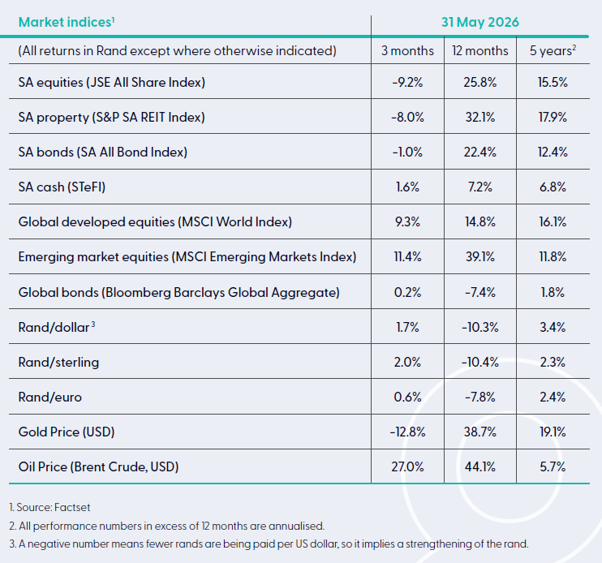
Global equities delivered strong gains in May. In the United States, the S&P 500 rose by 5.3%, driven largely by strength in the technology sector, where companies such as Nvidia continued to capture investor enthusiasm. Europe’s Euro Stoxx 50 advanced 4.1% in euro terms, supported by better-than-expected corporate earnings, despite lingering consumer confidence concerns. Japan’s Nikkei 225 surged 6.2% in yen, buoyed by robust GDP growth and supportive government policies.
South Africa’s FTSE/JSE All Share Index slipped by 0.3% in rand terms, reflecting mixed performance across mining and financials, although consumer and technology stocks offered some resilience. Emerging markets overall had a standout month, with the MSCI Emerging Markets Index climbing 9.5% in US dollar terms, led by Taiwan and Korea, where AI-related growth drove double-digit gains.
Bond markets reflected the ongoing tension between inflationary pressures and growth concerns. In the United States, Treasury yields remained elevated, with the 10-year closing at 4.45%. The UK gilt market saw a mid-month rally as inflation slowed, bringing the 10-year yield to around 5.10%. In Japan, government bond yields edged higher, with the 10-year at approximately 2.8%, as speculation grew that the Bank of Japan might raise rates in June.
South African government bonds eased slightly, with the 10-year yield at 8.72%, down from 9.13% in April, following market expectations that the Reserve Bank would raise the repo rate to 7.0%. This move underscored the delicate balance between inflation control and fragile domestic growth.
Commodities added another layer of volatility to the month’s market narrative. Brent crude oil fell sharply, declining from USD 117 in April to around USD 107 in May. Prices fluctuated between USD 91 and USD 117 during the month, as geopolitical tensions in the Middle East and disruptions in the Strait of Hormuz unsettled supply expectations. Gold softened slightly, closing at USD 4,539 per ounce, down 1.6% from the start of the month.
Artificial Intelligence is going to take our jobs. Not.
“AI is not coming for your job. It’s coming for your mind”
- Tom Slater, Baillie Gifford
The debate around artificial intelligence (AI) is often framed in binary terms, either as a driver of efficiency or a threat to employment. However, a more nuanced perspective is emerging, suggesting that AI is likely to expand economic activity, reshape the nature of work, and redefine where value is created.
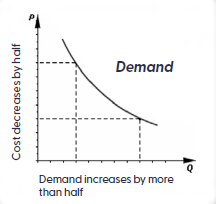
At a system level, economic theory provides a useful starting point. The Jevons Paradox, first observed in the 19th century, highlights that improvements in efficiency often lead to increased consumption rather than less. As technologies become cheaper and more effective, their use tends to expand across new industries, applications, and users.
Applied to AI, this dynamic implies that falling costs of computation, analysis, and content generation are unlikely to reduce demand. Instead, they are more likely to broaden its application, driving increased adoption and activity across the economy. What appears at first as a cost-saving technology may ultimately prove to be a demand multiplier.
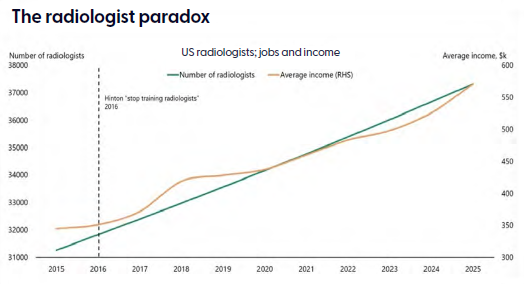
A useful way to understand this dynamic is through real-world evidence. In healthcare, where AI was once expected to replace radiologists, the opposite has occurred. Employment in the field has continued to grow, while compensation has increased materially. The reason is straightforward: reading medical scans is only one component of the broader profession. As AI makes this task faster and more efficient, the volume of scans increases, expanding the need for qualified professionals.
More broadly, declining costs have driven a significant increase in diagnostic imaging, supporting both higher employment and rising wages. This so-called “Radiologist Paradox” reinforces a key principle, that technology tends to automate tasks, not entire roles. As individual tasks become cheaper, the overall scope of the job can expand, whether through higher volumes, increased complexity, or new complementary activities.
While these dynamics point to a constructive outlook for economic growth and employment, the impact at an individual level may be more complex. As recent research from Baillie Gifford suggests, AI is not only changing what we do, but how we think. By reducing the effort required for cognitive tasks, it introduces the risk of shifting individuals away from deep, effort-driven reasoning towards faster, more surface-level outputs.
Over time, this may challenge the development of critical capabilities such as judgment, memory, and expertise - skills that remain central to long-term decision-making and value creation. The irony is that while AI has the potential to enhance productivity, it may also subtly erode the underlying human capital that supports it.
Taken together, these trends highlight a clear distinction. At the macro level, AI is likely to expand demand, drive investment, and create new opportunities. At the micro level, however, it may redefine the role of human input, placing greater emphasis on judgment, interpretation, and critical thinking.
For investors, the implication is that AI should not be viewed purely as a cost-reduction tool, but as a structural driver of growth and change. The key beneficiaries are unlikely to be those that simply adopt the technology most aggressively, but rather those that combine efficiency gains with strong human capabilities. In an environment where information is abundant and processes are increasingly automated, judgment may become the scarcest and most valuable resource.
Disclaimer
The information provided is of a general nature only and does not take into account investor’s objectives, financial situations or needs. The information does not constitute financial product advice and it should not be used, relied upon or treated as a substitute for specific, professional advice. It is, therefore, recommended that investors obtain the appropriate legal, tax, investment and/or other professional advice and formulate an investment strategy that would suit the investor’s risk profile prior to acting on such information and to consider whether any recommendation is appropriate considering the investor’s own objectives and particular needs. Although the information provided and statements of fact are obtained from sources that Analytics Consulting considers reliable, we do not guarantee their accuracy, completeness or currency and any such information may be incomplete or condensed. No guarantee of investment performance should be inferred from any of the information contained in this document. Collective Investment Schemes in Securities (“CIS”) are generally medium to long term investments. The value of participatory interests may go down as well as up and past performance is not necessarily a guide to future performance.
Any opinions, statements and information made available, whether written, oral or implied are expressed in good faith. Views are subject to change, without prior notice, on the basis of additional or new research, new facts or developments. All data is in base currency terms unless otherwise indicated, and sourced as disclosed.